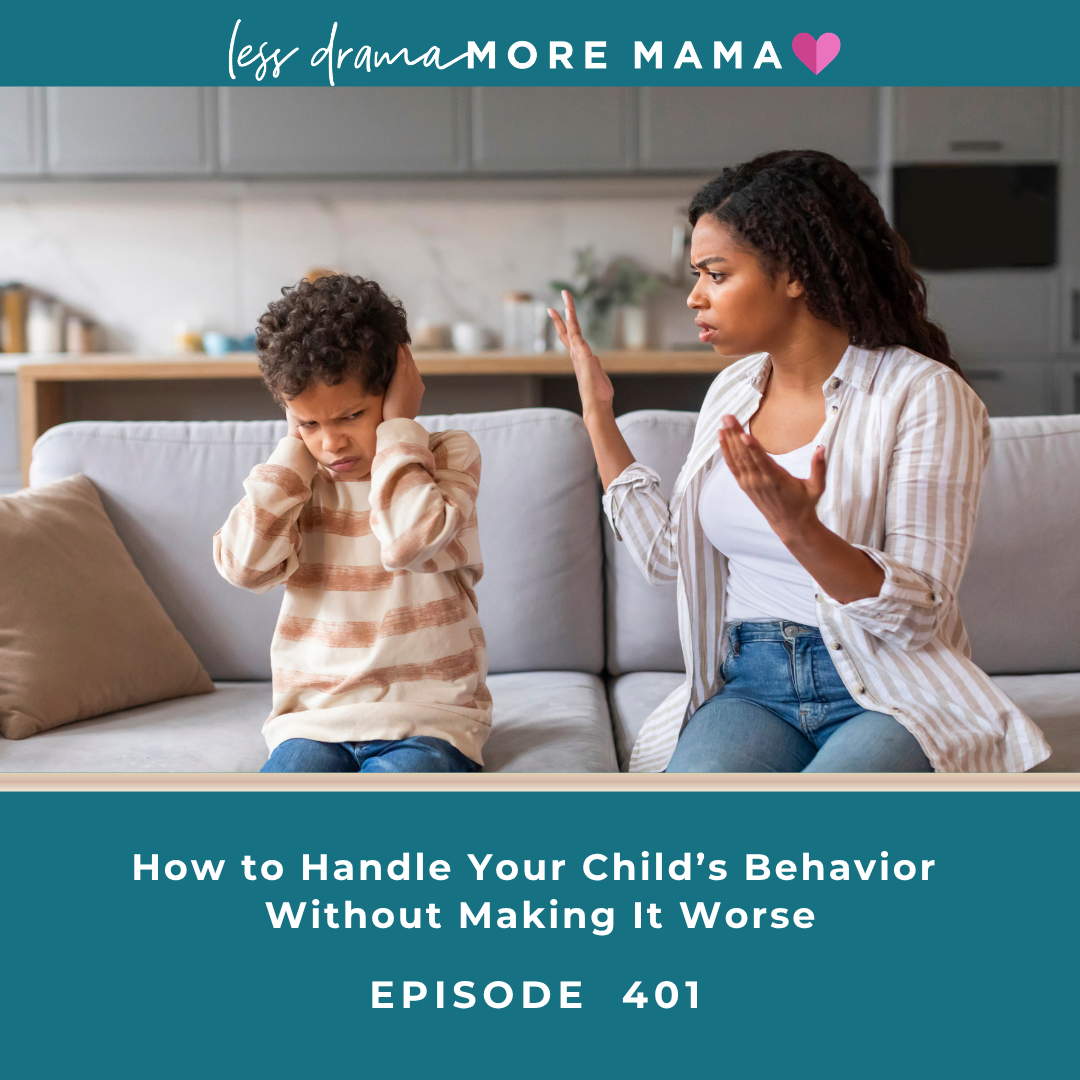
You are listening to the Less Drama More Mama podcast, episode 401: How to Handle Your Child’s Behavior Without Making It Worse
This is Less Drama More Mama, the podcast for moms who want to feel calm, in control, and confident about how to handle anything life throws their way. If you’re ready to go from feeling frazzled and disrespected to feeling calm and connected, this is the podcast for you. I’m your host, Pam Howard.
Hey Mama, welcome back to the podcast. I’m so glad you’re here. Have you ever been in a situation with your child where you knew, mid-sentence, that you were making it worse? Like, you could feel it escalating, you could see the expression on their face changing, and some part of your brain was saying stop talking, stop talking, stop talking. But you kept going anyway? Yeah. Me too. Today I want to talk about five things we do as moms that can feel like good parenting choices in the moment, but actually pour gasoline on the fire. And for each one, I’m going to give you something simple you can do instead. Many of the examples I give involve younger kids, but everything absolutely applies to older kids and teens as well.
Number one. Arguing logic with a dysregulated child. Your kid is melting down because you cut the sandwich wrong. And you hear yourself say, “But you said you wanted it cut in triangles. You told me triangles, remember?” And now you’re in a debate. With a six-year-old. About geometry. They’re flooded. Their brain has left the building. And you’re standing there making a very reasonable case to someone who cannot hear reason right now. Logic requires a calm brain. So what works better is getting quiet. Getting on their level. Getting close, if they’ll let you. You don’t have to say anything brilliant. You can say, “I see you’re upset. You didn’t want the triangles.” Or say nothing at all. Wait for the wave to pass. The sandwich conversation can happen later, if at all. Half the time they’re just hungry. They calm down, eat the sandwich, and never mention triangles again.
Number two. Overexplaining. This one is sneaky because it sounds very mature. Very conscious. You’re not yelling. You’re not threatening. You’re calmly explaining, for the fourth time, why we don’t hit our sister. It sounds like this: “When you hit your sister, it hurts her body. And when someone’s body gets hurt, they feel scared. And when people feel scared, they don’t want to play with you anymore. And I know you want people to play with you. So that’s why we use gentle hands. Because gentle hands keep everyone safe. And when everyone feels safe…” Mama. They stopped listening forty-five seconds ago. Overexplaining feels like teaching. But to your kid it sounds like the teacher in a Charlie Brown cartoon. Wa Wah Wa Wah Wa Wah. And the longer you talk, the more they check out, which makes you talk more, which makes them check out more. So, what works better? One sentence. Maybe two. “I won’t let you hit your sister.” That’s the boundary. It’s clear. It’s kind. It’s done. You can talk about feelings and friendship and gentle hands later, when everyone’s calm and maybe eating a snack. The teaching moment is not during the moment.
Number three. Matching their energy. They slam the door. You open it and slam it harder. They raise their voice. You raise yours louder. They roll their eyes and stomp off. You follow them down the hall with a speech about respect. This one feels like holding a line. Like if you don’t match them, you’re letting them get away with it. But think about what’s really happening. There’s a dysregulated child. And now there’s a dysregulated adult. Two people in survival mode and nobody steering the ship. When you match their energy, now there are two escalated people in the room. And it just keeps building from there. What works better? Drop your volume. Slow your pace. Just a little quieter and a little slower than them. Your kid might not calm down right away, but you’ve stopped it from escalating. You’ve given their nervous system something to co-regulate with instead of something to fight against. And you don’t have to be all Zen about it. You can be firm and kind at the same time. “I’m not going to talk to you right now. I’ll be in the kitchen when you’re ready to talk respectfully.” Then walk away.
Number four. Trying to control the outcome. This one shows up in examples such as forcing an apology. Telling them to stop crying and calm down. Insisting they hug grandma. And coaching them on exactly what to say to their teacher. It feels like good parenting because you’re involved. You’re staying on top of things. You’re trying to make sure everything goes well. But your kid experiences something different: I don’t get to feel what I feel. I don’t get to move through this in my own way. Mom needs this to go a certain way, and it’s my job to make it happen. That’s a lot for a kid to carry. What works better? Notice what’s happening. Set a boundary if there is one. And then let them have their experience. It can sound like: “It looks like you’re not ready to apologize yet. That’s okay. You can do it when you mean it.” “You’re really upset right now. I’m here with you.” “You don’t have to hug grandma if you don’t want to.” Or, “You can figure out what you want to say to your teacher. I trust you.” This takes practice, because it means allowing some discomfort. Your kid’s discomfort. Grandma’s reaction. That feeling in you that says, “I should be doing more right now.” But a kid who gets to move through things at their own pace learns to trust themselves. And that matters way more than a forced apology that doesn’t mean anything.
Number five. Moving to the lesson before the emotion has passed. Your child falls apart because their friend was mean at recess. They’re crying. They’re red. Their voice is shaky. And before the tears have even slowed down, you’re in there with, “So what do you think you could say to her the next time?” Or your kid gets in trouble at school and they’re clearly embarrassed and upset, and you say, “Okay, so what did we learn from this?” The lesson is a good instinct. You want to help them grow from it, but timing is everything. When your kid is still in the feeling, their brain is not available for a learning conversation. You’re trying to talk to the upstairs brain while the downstairs brain is running the show. And what your kid hears when you jump to the lesson is: your feelings are in the way. Hurry up and get done with that so we can get to the useful part. That’s not what you mean. But that’s what gets communicated. What works better is letting the feeling finish. Sit with them in it. You don’t have to fix it. You can say, “That sounds really hard.” You can say, “I’m so sorry that happened.” You can just be there. The lesson will land so much better in an hour. Or at bedtime. Or tomorrow. When they’re calm and they feel close to you and their brain has space for it. I tell the moms I work with all the time: connect before you correct. Connection first, correction second. Always in that order. Because a kid who feels heard is a kid who can actually take in what you’re trying to teach them. A kid who feels rushed past will shut down every time.
So here’s what I want you to notice. There’s a thread running through all five of these. In hard moments, our instinct is to do more. Say more. Explain more. Fix it faster. And that’s usually what makes it worse. What helps is to say less. Slow down. Give more space. Your child doesn’t need more from you. They need you regulated. They need you present. And they need you to trust that they can move through what they’re feeling without you trying to rush it or fix it. That’s it. If this episode made you think of a specific moment with your child, I’d love to hear about it. Send me a DM on Instagram at @lessdramamama, and if there’s a mom in your life who needs to hear this one, please send it to her. Thanks so much for being here. I’ll talk to you again next week. Bye.
If you enjoy listening to this podcast, and you’re ready to feel calmer, more confident and more at peace in your family and life, I invite you to sign up for a free consultation with me to learn about how my coaching can help you achieve the exact life you want. You’ll take the concepts and tools I share in the podcast and apply them to your own life, and as your coach I’ll be there to support you every step of the way. Go to lessdramamoremama.com/mini and sign up now.