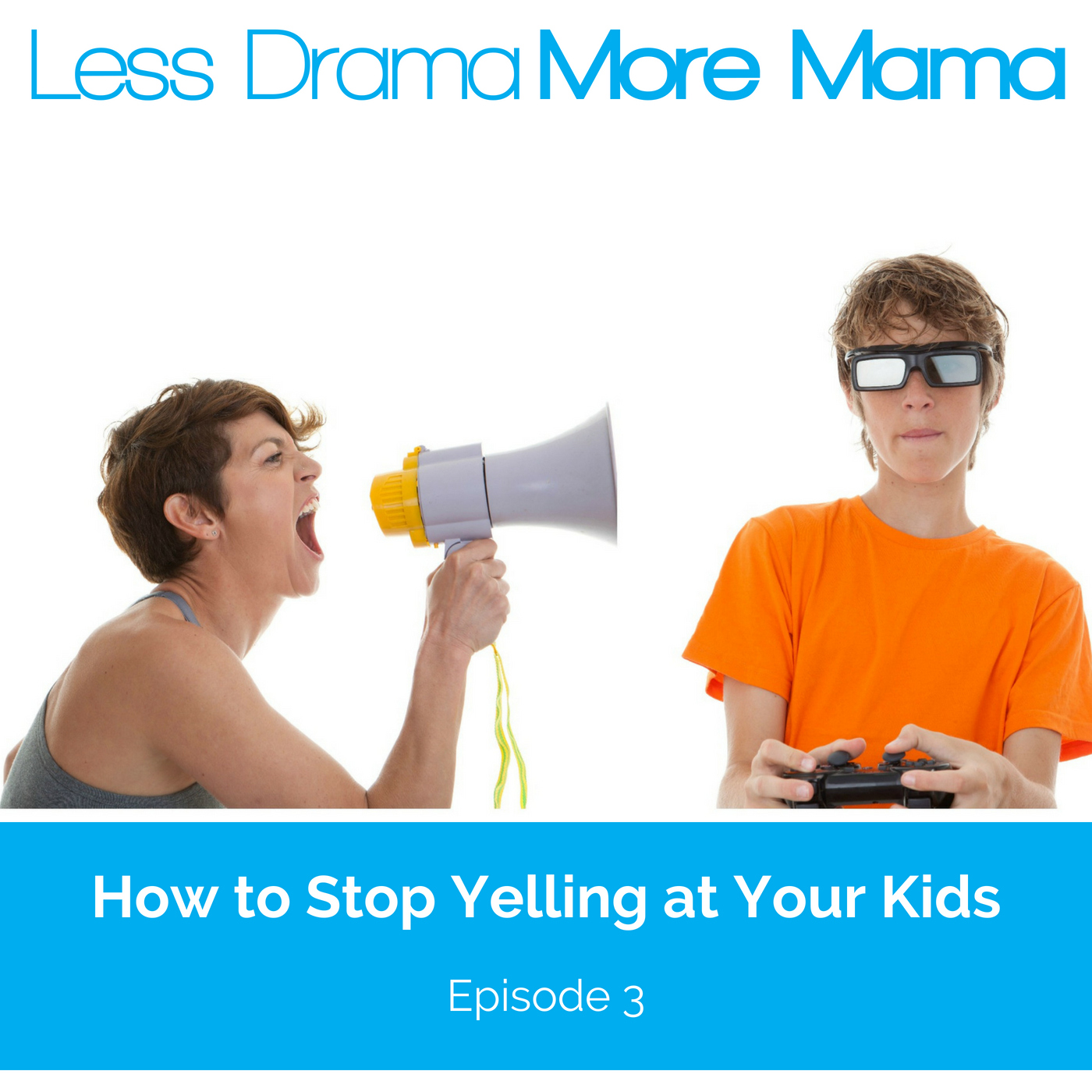
You are listening to the Less Drama More Mama podcast, episode 003: How to Stop Yelling at Your Kids
This is Less Drama More Mama, the podcast for moms who want to feel calm, in control, and confident about how to handle anything life throws their way. If you’re ready to go from feeling frazzled and disrespected to feeling calm and connected, this is the podcast for you. I’m your host, Pam Howard.
Hello, hello!
Welcome back for episode 3. I hope you’re enjoying listening to the podcast as much as I’m enjoying recording them for you! Someone asked me recently why I was starting a podcast and I told her that, first of all — I love listening to podcasts. I listen to them every day. I’d much rather listen to a podcast than watch TV. Because when I listen to podcasts, I learn so much about how to create a better life for myself and my family and how to best serve my clients. I’ve always been sort of a self-help junkie, too, so…
I also love podcasts for their convenience and because I can listen to them anywhere. I usually listen in the car, while I’m getting ready in the morning, before bedtime…and there are certain people that when I’m listening to them and their podcasts, I think, “you know, I bet we would be great friends.” So sometimes I just pretend we are friends and they just don’t know about it yet. So, maybe you and I will become friends, too, right? That would be awesome!
But the other reason I wanted to start a podcast is that I really feel passionate about my work and I feel like it’s my purpose in life to help moms and kids. And I hope that a ton of moms listen to this podcast, but even if just one mom feels better about herself and her situation from something she hears here on the podcast, it’ll be so worthwhile. And if that’s you — if you hear something that resonates with you or changes your perspective about something, please leave a review in iTunes and let me know!
Ok, on to today’s topic: How to stop yelling at your kids. Hal Runkel, who is the author of the book ScreamFree Parenting and a past mentor of mine, says that our biggest enemy as parents is our own emotional reactivity. He says that emotional reactivity is when we give into our anxiety and let it drive our behavior.
So, let me explain what this means.
In episode 2, I talked about how our thoughts create our feelings. And if you haven’t listened to that, you gotta go back and listen to it. It’s super important. Our thoughts create our feelings. And our feelings drive our actions. For example, when I tell my daughters to stop fighting in the back seat (and this is totally hypothetical, of course right? – because my daughters would never fight…ha!) Uh, no, just kidding! But when I tell them to stop and they don’t stop fighting… and I have a thought that they shouldn’t be fighting, that thought would cause me to feel powerless and frustrated…and those feelings would probably cause me to lose it right? I’d yell, I’d scream, I’d basically revert to toddlerhood and have what I call a Mama Meltdown. Now, it’s, it’s really important to understand, again, that it’s not my girls fighting that would cause me to feel angry. It’s my thought that they shouldn’t be fighting when they are — that would cause me to feel angry. That’s a huge distinction and it puts me in a much better place because I’m responsible and in control of how I think. So I’m in control of how I feel.
The reason we get reactive and feel so out of control has to do with how the brain works. Stay with me here. When I first heard other people talk about the brain, I immediately tuned them out. I was like: brain equals science equals fancy terminology that I don’t understand. So, for those of you who might feel that way, I’m going to try to break it down and explain it in exactly the same way I explain it to my elementary and middle school students. For those of you who already understand this stuff, you might want to explain it to your kids this way, though, so keep listening.
There are lots of parts of the brain, but I’m only going to talk about two of them today. There’s the downstairs brain, known as the limbic system, and the upstairs brain, the cerebral cortex. Now, the downstairs brain is the part of our brain that is conditioned to keep us alive. Back when humans lived in caves, this part of our brain was very useful because it was always looking out for danger in the environment – and when there was such a danger, like a tiger, it would release hormones to prepare the body to either stay and deal with the threat or to run away to safety. Right? You’ve probably heard of fight, flight, or freeze.
So the downstairs brain is still useful in situations that pose serious threats. But it’s important to note that the brain doesn’t know the difference between a real threat and an imagined threat. So this means that when your child is throwing a tantrum in public or talking back to you, or acting defiantly, your downstairs brain defaults to danger! Danger! Child crying! Something has gone terribly wrong and we’re all going to die. Okay? Even though there’s no actual danger, the primitive part of your brain jumps into action to protect you. Not from physical pain, but from emotional pain. From feelings of powerlessness, embarrassment, inadequacy. When I describe this part of the brain to kids, I call it the barking dog. So, the barking dog starts barking like crazy to keep you alive and keep you safe.
Once you yell at your child the first time, and you get the reward of compliance from them or a sense of power or relief, that action gets reinforced in the brain. Even though consciously you don’t feel good about yelling, your brain files it away in your subconscious as something that protected you in that moment of perceived crisis. And the next time you find yourself in a similar situation, you’re very likely to yell again because the brain wants to be efficient. In effect, the barking dog is being trained to bark whenever your toddler has a tantrum.
Then there’s the more evolved, logical, thinking part of your brain, or what I call “the wise owl.” The wise owl knows that there’s no actual threat to your survival. She knows that your child is just expressing his feelings and that everything’s going to be ok. She tells the barking dog, “It’s ok, dog. We got this. Nothing’s gone wrong here. We’re going to find a solution.”
The problem is that when the dog starts barking, the owl flies away. So we need to simultaneously train the owl and the dog to recognize when there’s an actual threat that warrants the dog barking, or just a perceived threat, where the owl can take over.
In his book, the 7 Habits of Highly Effective People, Dr. Stephen Covey talked about Habit #1 – Be Proactive. Being proactive is the opposite of being reactive. And Covey said that proactive people recognize that they are in control of their responses. He says they’re “response-able.”
A lot of people use the words reaction and response interchangeably, but let’s talk about the difference here for a minute. A reaction is immediate and not thought-out, like when you’re on the phone and your child is saying, “Mommy, mommy, mommy” and you yell, “Can’t you see I’m on the phone?” Wait! That’s your unconscious, knee-jerk reaction, caused by a feeling of irritation or frustration. A response would be more thoughtful and deliberate. You create a pause between the stimulus and your response to be able to choose what you want to do. So, you might say, “Honey, I’m on the phone right now. Please come back in 5 minutes.”
By the way, is it just my kids or do yours think that when you’re holding a phone to your ear, that’s the perfect time for them to strike up a conversation with you? Ok, I– sorry– I digress.
Sometimes a reaction and a response look exactly the same, but they feel completely different. For example, let’s say your child is having an emotional meltdown in public and you give her a snack. It’s a reaction when you give her the snack out of fear or embarrassment or guilt to keep her quiet. It’s a response when you give her the snack from a genuine place of love and a desire to help her feel better because you suspect she’s hungry. Or say you didn’t give her the snack. Again, it’s a reaction if you didn’t give it because you were feeling annoyed or threatened by her outburst. It’s a response if you didn’t give the snack because you know she doesn’t need a snack, she needs a nap, so you decide to make your way to the checkout line and go home.
Learning how to respond, rather than react, is a skill that can be learned. I want to give you an example of the first time I realized the difference for myself and put it into action. When Marissa was three, she refused to get out of the bath even though I had told her several times it was time to get out. And I felt a surge of frustration bubbling up in my chest. It was preceded by the thought, “She should listen to me the first time.” Prior to this, my usual reaction was to raise my voice at her or just pick her up out of the bath against her will. This time, I consciously chose my response. First, I had the thought, “Of course she doesn’t want to get out of the tub. It’s so much fun in there with her toys and the warm water.” This thought caused me to feel compassionate towards her and I immediately felt calmer.
Then, like a preschool teacher who lowers her voice when she wants the class to quiet down, I said, “I know it’s really fun in there, but it’s time to get out of the tub now.” I also gave her a choice, I said: “You can choose to get out of the bath on your own, or I’m going to pick you up and take you out.”
So she stayed in the tub. That was her choice. And I took her out. That was mine.
By consciously choosing my emotional response, instead of becoming reactive, I regained my sense of control: not over Marissa, but over myself. The best part was that there was nothing to blame her for or to get angry about. She simply made her choice and I made mine.
Now, I’m sure some sort of temper tantrum ensued as a result of me extracting her from the bath. Right? I’m sure she got upset. But I remember feeling so proud and so good about myself because I showed up as the mom I wanted to be: calm, connected, and confident.
What I help moms do through my coaching, is help them use the conscious part of their brains to be proactive and choose and practice the thoughts that lead them to better feelings, actions, and results. It’s only by examining the thoughts that cause you to yell that you’ll be able to create long-lasting change. Now, this doesn’t mean that you don’t have limits and consequences. It doesn’t mean you’re passive at all. It means that you show up in a way that’s deliberate, in control, and completely cool-headed.
I’d like to invite you to a FREE mini-session where I can show you exactly how my coaching works. A mini-session is a 15-30 minute phone conversation to address one problem you’re facing now. And I promise, there’s no pressure to buy anything, so you really don’t need to worry about that. I only offer three mini-sessions a week, though, so if you want one, go to lessdramamoremama.com/mini m-i-n-i to sign up.
Ok, mama. Notice your emotional reactivity this week. Notice that your brain thinks there’s danger, when there isn’t any. And when that dog starts barking, take some deep breaths, find a better thought to think about your situation, and let the wise owl take over.
Have a wonderful week. I’ll talk to you soon. Bye bye.
Thank you for listening to the Less Drama More Mama podcast. If you liked this episode, please take a moment to write a quick review on iTunes and make sure you subscribe, too, so you never miss a show. Got a question, comment, or idea for an upcoming episode? Email me at pam@lessdramamoremama.com