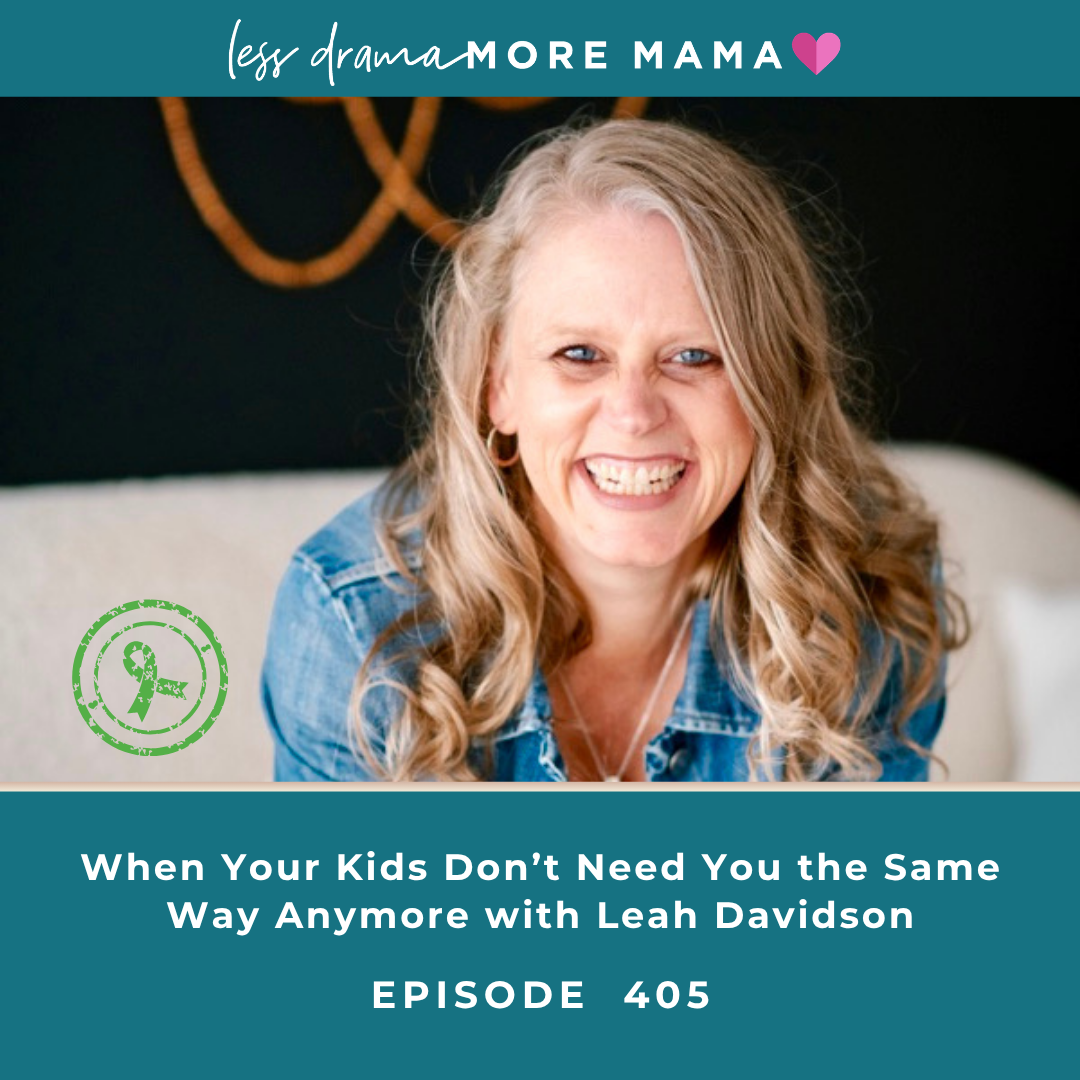
You are listening to the Less Drama More Mama podcast, episode 405: When Your Kids Don’t Need You the Same Way Anymore with Leah Davidson
This is Less Drama More Mama. The podcast for moms who want to feel calm, in control, and confident about how to handle anything life throws their way. If you’re ready to go from feeling frazzled and disrespected to feeling calm and connected, this is the podcast for you. I’m your host, Pam Howard.
Hi Mama. Before we dive into today’s episode, I want to let you know about something a little different I’m doing this month. Since May is Mental Health Awareness Month, I put together a small podcast collaboration with a few other hosts who all talk about parenting, anxiety, and emotional health. These are women whose work I respect and who are having conversations I think you’ll really benefit from hearing. Each week, I’ll share one of their episodes here on this podcast. And at the end of each one, I’ll come back and share a few of my own thoughts about it.
Today’s episode comes from Leah Davidson’s podcast, Building Resilience. Leah has been a guest on the Less Drama More Mama podcast before. She’s a speech-language pathologist and nervous system resilience coach with over 26 years of experience in brain and nervous system health. She works primarily with women in midlife, helping them understand their changing nervous systems and build resilience from the inside out.
This episode is especially helpful for moms of teens, young adults, or older kids who are trying to figure out how to stay connected without overfunctioning. If you’ve been feeling unsure about when to step in, when to stay quiet, or how to stop taking your child’s independence so personally, I think you’ll get a lot from Leah’s perspective.
One of the reasons Leah chose this episode is because she feels there’s so much support out there for parenting younger kids, but not nearly as much for this stage. And yet, this is where things can start to feel the most confusing. Your role shifts. The relationship changes. You may go from being very involved in your child’s day-to-day life to feeling more on the outside, observing instead of guiding.
She talks about how this transition can bring up a mix of emotions like love, grief, frustration, and the pull to overfunction or try harder to stay connected. And what she offers in this episode is a different way to think about that. Instead of trying to manage or control your child’s experience, the focus becomes learning how to regulate yourself. So take a listen, and I’ll meet you back here at the end to share a few of my thoughts.
Hello, hello, everybody. Welcome, welcome. How are you doing? Now, I want to remind you, in case you haven’t heard, I have been making some transitions and fine-tuning my niche with more of a focus on midlife. We are still going deep on all things nervous system, but as I am in the midlife season, I see how a lot of the stuff out there talking about the nervous system doesn’t quite resonate with all the things that happen in midlife. So that is where the shift of my focus is coming from. And many people in my community are also midlifers. So it felt like a very logical and a nervous system aligned shift. So for that reason, I’ve relaunched the nervous system journaling club to the midlife nervous system rewire community. And I want to invite you to come on in and join us. The link will be in the show notes.
Okay, so today we’re continuing the conversation about the role of regulating your own nervous system. Last week, we talked about younger kids and today older kids, including young adults. I want to talk about how regulation changes when your kids no longer are directly almost borrowing from your own nervous system, as we talked about last week. How your kids feel and use your nervous system more than the words or the actions that you use. And while this changes as your kids get older, they actually still feel your own nervous system a lot.
So as kids get older, your role as a parent, or for me as a mother, changes. You’re still their mom, but you’re no longer needed in the same constant physical and very obvious way. And of course, for many women, this brings up a mix of emotions that they don’t always feel allowed to name or often talk about that. Grief, confusion, relief, sadness, excitement, longing, and a sense of where do I put all this energy and care now? And sometimes at the same time, the nervous system strategies that you’ve relied on for years: anticipating everything, managing everything, trying to fix everything, holding things together for everybody. They don’t work the same way. And they can start to create friction instead of connection. So it’s almost like a developmental shift for you and your nervous system.
Now, when your kids are little, as we talked about last week, they almost always borrow your nervous system. They sense your system. They pick up on all the subtleties. The calm of your nervous system settles them. Your attention activates them. But when kids are older, they don’t borrow your nervous system in the same way. They don’t borrow your regulation anymore. They react to it.
So if your system is anxious or tight or braced, they don’t absorb it like they might’ve done when they were younger. Now they’re going to push against it. And if your presence carries urgency and expectation or emotional weight, they feel pressure. So you can use an analogy like riding a bike. When kids are little, it’s like you hold on to the bike for them as they ride. But as they get older, you’re no longer holding the bike, but you’re walking or sometimes running beside them. And if you decide to keep reaching for the handlebars to control or steer, even if you’re well-meaning, even if you’re lovingly doing it, it doesn’t feel supportive to them. It can actually feel very intrusive.
And this can really feel confusing as a parent because what once looked like your love and care now lands as control, even when your intention hasn’t changed at all. So we may feel the shift. We may interpret it as being rejection or being dismissed or a lack of care. So sometimes what we do is we try to push even harder. We’re convinced that we have the solution and this usually doesn’t go over very well. We are so used to reacting. And so we end up almost parenting from what could be considered more of a parenting reflex instead of response. So we step into this reflex to fix, a reflex to advise, a reflex to smooth things over, a reflex to hold emotional space, even when that was never asked for. And I will be honest, I have lived this and to a certain extent am still living it. I have kids who at times get snippy and frustrated or sharp with me. And of course that pushes my buttons. I start thinking about like the nerve they have after all I’ve done for them, the sacrifices I’ve made. So my nervous system then gets even more activated, even defensive and tight. And I’m ready to engage. I am ready to meet their fire, their level of dysregulation with my fire and my level of dysregulation. I like to say, I see their fire and I will raise their fire. And then we will just be one-upping each other all the time.
But after some very messy situations where dysregulation on both ends turns to a lot more conflict than what I want, I have learned to try instead of trying to make them calm down or to be reasonable as I see it or to even see it my way, I am learning that it is better just to focus on regulating myself. The more regulated I am, the more choices I have. I have the choice to ignore what doesn’t need engagement. I have the choice to respond calmly instead of reflexively. I have the choice to be present without absorbing their stress. And importantly, I have the choice to set boundaries without escalating anything.
Because regulation certainly doesn’t mean tolerating mistreatment. It’s not about turning a blind eye to disrespect or even abusive behaviors, but it’s about coming from regulation so you can be clear about what your boundaries are and what you want to enforce. And remember, boundaries are not about forcing others to do something. They are about protecting yourself and what you will do if those boundaries are crossed. So when we keep and enforce boundaries when we’re regulated, we can do so more effectively and from a place of love.
Now, many of us are still kind of under the illusion that we can control our kids regardless of their age, that we can control them into regulation. We can try to force them to calm down or to make sense or to do something different. But trying this way often backfires. You can’t regulate older kids by controlling them. Now, don’t forget, as these kids get older, or are older now, even they’re emerging adults, they are also navigating identity shifts, independence, relationships, pressure, uncertainty, and often all at once. So of course, they are also going to get regulated just like we do.
And what we also know about their brain development is that their brain, their CEO, their prefrontal cortex is developing. And it is only going to be more fully developed by the time they hit their mid to late 20s. So regulation can actually be a challenge from that perspective too, developmentally. But as parents, if we respond to their dysregulation with urgency or advice or emotional intensity, and again, don’t take it personally, I do this all myself, their nervous system can end up reading this as pressure and not care and concern as you likely mean. And so that can impact connection.
Now, connection at this stage doesn’t actually deepen with more effort. It often deepens with more restraint. If we are interacting and dysregulated ourselves, it just adds more pressure for them, more to care about, more worry. And that will create even more distance. So think about it this way. You don’t lean into somebody to create closeness. You create enough space for them to come toward you. So your own regulation can help create that space your kids need to figure things out. To be a bit irrational and to build the resilience as they try to figure these things out. So the space you’re giving them by you being regulated and often just letting them fend for themselves to figure things out, not to jump in to save them or not to jump in to criticize them or even advise them, that space is not indifference. It is actual respect. And trust me, this can be hard to do.
I have tried to control regulation many, many times. I’ve tried to advise and fix and protect and rescue. I still do it. And I try to catch myself so that I’m not depriving them of the experience they need to build their own regulation and their own resilience. And creating that kind of space that they need does require a very different nervous system than maybe the activated one that I often go to.
Now, which brings us to the real work of this stage. The focus is not actually about them or on them. It’s about you. With older kids and young adults, regulation stops being about managing their emotions, their temperaments, their reaction, their words, but becomes about managing more of your own. And that can look like staying grounded when they pull away. Or just letting conversations be incomplete. Allowing disappointment for both you and them without collapsing or hardening or feeling guilty or apologizing to them.
This is where your own nervous system regulation becomes self-trust. A trust in you and a trust in them. Trusting that you don’t need to chase closeness. Trusting that your own worth isn’t measured by how needed you are. And trusting that connection doesn’t require your over-function. And trusting that they got this, that they need all the experiences, that they can figure things out on their own, that they have the resourcefulness, or if not, they will develop it. So your calm then becomes a boundary with them. And that can feel very uncomfortable at first because for many mothers, doing less feels like caring less, even when that is not true at all.
So then in real life, dealing with these older kids and young adults, what does regulation actually look like? Well, often it starts with a pause before engaging in any interaction. And you are pausing not to find the perfect words, but to check in with your own state. Am I regulated right now? Am I anxious for connection? That question alone can shift the entire interaction. Silence matters more in this stage than we’re taught to believe. Just keep your mouth shut. And I’m not talking about a cold silence or withdrawal, although that can be hard not to slip into as well, but a silence that isn’t trying to control the outcome. One that is just there while you listen.
So my husband and I joke that when we’re talking to our kids, we are learning more and more to almost pretend it’s like we’re grabbing some popcorn, pulling up a chair and watching the show, the show of their life and their ups, their downs, their stories. And as much as we want to jump in, which we sometimes do, I will admit it’s hard not to. And some of our kids actually want us to jump in, but we have to wait for them to ask. But we are only the audience to the movie. So we really do need to stay quiet. Now it is hard to do after years of being more involved and more vocal, but we try to stay quiet. And I do emphasize the word try. Although to be fair, like I said, some of our kids want more input than others.
Now, another key shift is letting go of over-functioning for closeness. We used to have a saying when I worked as a speech language pathologist with clients who had traumatic brain injury when I was working on teams, that you should never be working harder than your client. Because honestly, we often did. I mean, some people really wanted the support and the therapy, but some just didn’t. They were being forced to be there by their lawyers, their insurance, or if they were younger, by their family members. But it never worked out well if that was the case. It was very stressful to work with clients like that. So you learned that they also needed to have buy-in. Some of them were just not ready or did not have a capacity at that moment. And that can actually happen with your kids as well. They are transitioning. They are growing and blooming and pruning. So that puts a lot on them. And so trying to maintain the whole relationship on you can start to be a lot for your own nervous system.
So if closeness to them costs your nervous system, if it requires this constant vigilance, or worry, or self-adjusting, or self-abandonment, it is not sustainable. You need to take care of you. It is not abandoning your child or not caring, but it is taking care of you. Because really, the most powerful thing you can model now is not advice or answers. It is how to be regulated, how to stay anchored in yourself, how you tolerate discomfort, how you don’t chase, or you don’t collapse. How you come back to your own center over and over and over again, how you build and lead your own life.
Now, you’re still loving the members in your family and the friends that you have, but you’re not putting yourself last all the time. And then in turn, that teaches them more than words ever could. So to help you start to reflect on where you’re at, if you have older kids, a couple of things to consider and reflect on, or maybe even journal about. Where am I confusing effort with connection? Because often that is what we do. We think more effort, more rescuing, more enabling means more love and more connection.
What emotions come up when my child doesn’t need me the way they used to? It’s really important to build some awareness about this. And again, it is all normal, but it’s good to see what is happening for you. And finally, what would it look like to trust myself and then to trust them instead of trying to manage the relationship? We definitely want to be asking these questions or reflecting from a place of curiosity and regulation and not a place of shame.
Parenting older children really does ask something different of our nervous system. It is a big transition for those of us with kids when we’re in midlife. There is less doing, less fixing, but a lot more regulation, a lot more restraint, and a lot more trust in who we are beyond the role that we played for so long and who they are now and who they are becoming. Your nervous system matters even more now. It still sets the tone, but your own regulation is really the secret to a healthier, more connected relationship with your kids, with your partner, with yourself.
Alright, thank you, Leah, for sharing that episode. I want to highlight a couple of things that stood out to me. I really liked the way Leah described that shift from holding onto the bike handlebars to walking alongside the bike. When kids are little, we’re very hands-on. And as they get older, there’s an ongoing letting go of control. The more you step in and do for them, the more tension it can create in the relationship.
What she’s pointing to is that connection often comes from giving your child enough space so that they can come toward you. And that leads into the bigger shift, which is moving your focus from them to you. For a lot of moms, that can feel unfamiliar and uncomfortable. You may have learned that you’re supposed to manage your child’s behavior or that how they act reflects on you. So turning your attention inward can feel counterintuitive. But the more you focus on your own emotional regulation, the easier it becomes to stay connected to yourself and your kids. If this episode resonated with you, I’d encourage you to check out Leah’s podcast, Building Resilience. I’ll link it in the show notes so you can find her. Thank you for listening and I’ll talk to you again next week. Bye.
If you enjoy listening to this podcast, and you’re ready to feel calmer, more confident and more at peace in your family and life, I invite you to sign up for a free consultation with me to learn about how my coaching can help you achieve the exact life you want. You’ll take the concepts and tools I share in the podcast and apply them to your own life, and as your coach I’ll be there to support you every step of the way. Go to lessdramamoremama.com/mini and sign up now.